
MOQ Questions to Settle Before You Sign a Kids-Safe Order
The minimum order quantity is the clause buyers negotiate hardest and understand least, because the number itself is downstream of decisions made elsewhere in the agreement. Before signing a kids-safe production order, a buyer should be able to answer questions in four areas: what the minimum is made of, what happens if the delivered quantity differs, what documentation supports the product, and what changes the terms later. If any of those four is unanswerable in writing, the minimum is not settled either — it is only the part of the agreement you happened to notice.
Key takeaways
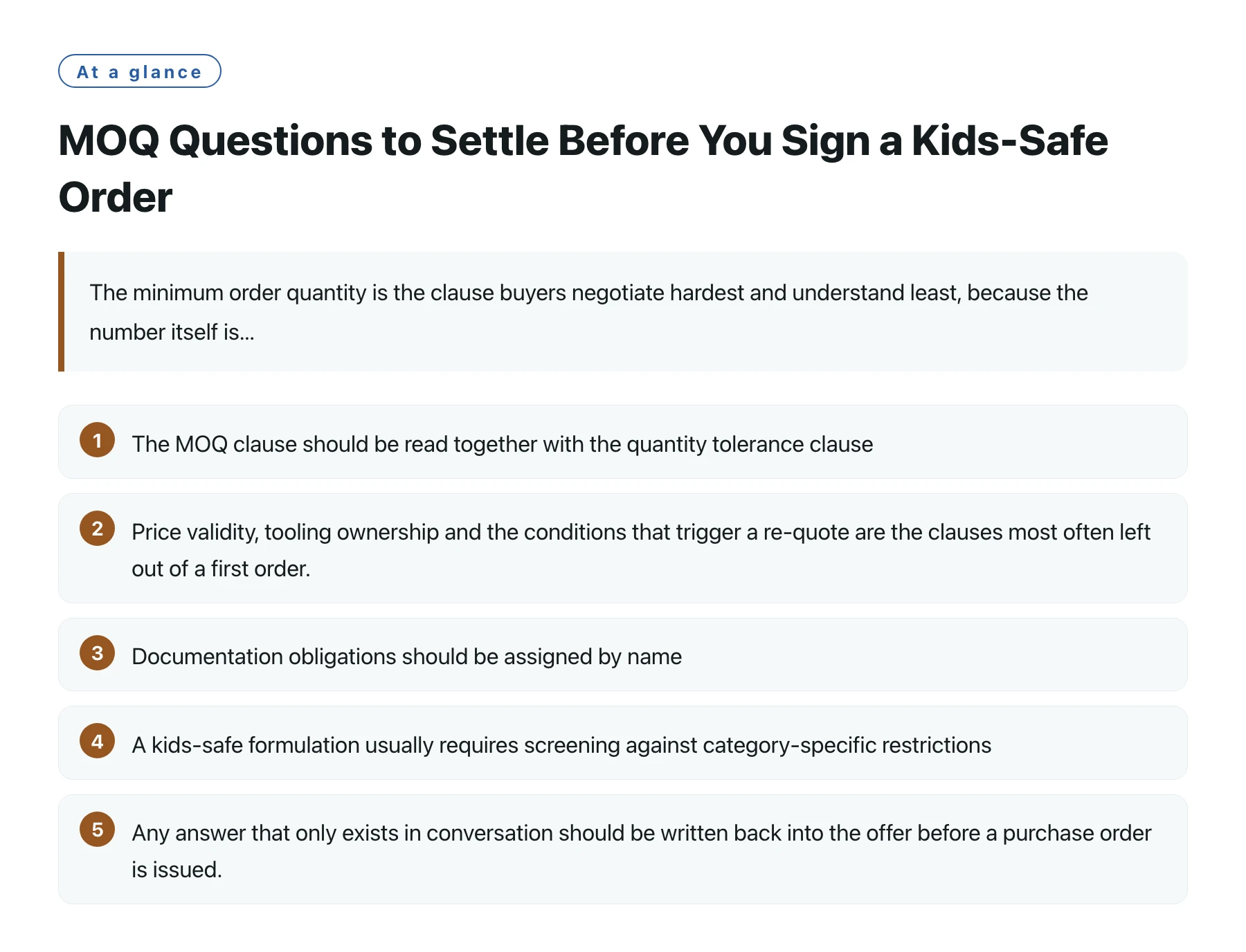
- The MOQ clause should be read together with the quantity tolerance clause, because the two together decide what you actually pay for.
- Price validity, tooling ownership and the conditions that trigger a re-quote are the clauses most often left out of a first order.
- Documentation obligations should be assigned by name, with the format and language stated, rather than described as compliance support.
- A kids-safe formulation usually requires screening against category-specific restrictions, which belongs in the agreement rather than in an email thread.
- Any answer that only exists in conversation should be written back into the offer before a purchase order is issued.
Negotiating a minimum order quantity feels like the main event because it is the number that decides whether the project starts at all. It is not the clause that causes trouble six months later. Quantity tolerance, price validity and documentation obligations cause far more disputes, and they are usually signed without being read.
The questions below are grouped the way a contract review tends to unfold: first the commercial terms around the minimum, then the product and documentation, then the things that change with time.
Questions about the minimum and the quantity itself
Start with the number and work outward. The aim is not to reduce the minimum but to understand what produced it and what happens around it.
A useful reference point is the sequence of operations a factory actually runs, since it explains why a minimum exists in the first place; the explanation of the stages of perfume production is a reasonable thing to have read before the conversation, so that the answers you receive can be checked against a process rather than accepted on trust.
Is the minimum per order, per scent or per component?
These are three different commitments. A minimum per order may allow several scents if they share a base. A minimum per scent means each fragrance carries its own bar. A minimum per component means the bottle, the pump or the carton is the constraint, and the liquid volume is almost irrelevant. Ask which applies, and ask it in writing.
What is the permitted tolerance on delivery?
Most production runs deliver slightly above or below the ordered quantity. The agreement should state the tolerance band and how it is billed. A tolerance that is generous in one direction and narrow in the other is a cost the buyer absorbs.
Are the price breaks tied to the same specification?
A price break at a higher quantity is only useful if nothing else changes. Confirm the pack, the scent source, the documentation scope and the delivery term are identical across the bands. If the specification moves with the volume, you are comparing two different products.
Questions about documentation and product safety
On a kids-safe format, the documentation is part of the product. The questions below are the ones that should have named answers rather than general reassurances before a deposit is paid.
The regulatory landscape is not uniform. In the European Union, cosmetics are governed by a framework that sets out ingredient restrictions, labelling duties and the role of the responsible person [1], and the fragrance industry maintains its own standards for the safe use of materials by product category [2]. Neither of those sets of rules is something a first-time buyer can improvise at shipping time.
Who screens the formula, and against what?
Ask for the screening to be issued for your approved formula revision and your product category, not for the category the library scent was originally sold into. This is the single most consequential documentation question on a kids-safe order.
Which documents travel with the goods?
Get the list, the format, the language and the issue date for each item. A certificate of analysis, a safety assessment, an allergen declaration and a certificate of origin are four documents, often held by different departments inside the same factory, and each can delay a shipment independently.
What is retained, and for how long?
Ask about retained samples and batch records: what is kept, for how long, and who can retrieve it. This is also where intellectual property questions surface, since retained samples and process records may contain information the buyer considers confidential [3]. Deciding how that information is handled before production is easier than negotiating it afterwards.
Questions about what changes later
A first order is the start of a relationship, and the clauses that govern change are the ones that determine whether the second order is easier or harder than the first.
Buyers working with an overseas partner sometimes underestimate how much of this is standard practice. A contract perfume manufacturing in China arrangement usually involves a written offer, a deposit, a pre-production sample and a release inspection, and those four documents are the natural place to record the answers above.
Reviewing how comparable projects are scoped is a fair preparation step, which is why collections such as Xuelei are worth reading for the questions they surface rather than for the products they show.
How long is the price valid, and what moves it?
Component prices, freight rates and exchange rates all move. The offer should state a validity period and the specific inputs that trigger a revision, rather than leaving the buyer to discover it at the next purchase order.
Who owns the tooling and the print cylinders?
If a custom mould, decoration plate or print cylinder is paid for by the brand, the ownership and the right to retrieve it should be stated. If it is paid for by the factory, the brand should know what happens to the price if it orders again elsewhere.
What happens if the format is discontinued?
A kids-safe line may be a test. Ask what happens to the remaining components, the formula and the artwork if the range is paused. Planning the exit at the start is cheap, and it is the question most buyers only think of later.
The most reliable sign of a workable agreement is that the supplier answers a documentation question with a document. A brand owner who wants to see how a manufacturer describes its own obligations can start with XUELEI and read the service description alongside the certifications, then bring the same questions to whichever partner they are negotiating with. The comparison is the point: it shows the difference between a partner who has answered these questions many times and one who is composing an answer for the first time.
Sources
- European Commission: Cosmetic Products — Specific Topics —— EU pages covering specific cosmetics topics such as product claims, nanomaterials and animal-testing rules.
- IFRA Standards Library (International Fragrance Association) —— The IFRA Standards Library lists the restrictions the fragrance industry applies to individual fragrance ingredients, based on safety assessments; it is the reference point for compliant fragrance formulation.
- WIPO — World Intellectual Property Organization —— The UN agency for intellectual property; resources on industrial design and patent protection relevant to product and packaging design.
Frequently asked questions
Should the MOQ be in the purchase order or in a separate agreement?
Either works, provided the terms referenced by the purchase order are attached or clearly identified. What matters is that the quantity, tolerance, price validity and specification are all in the same document set, so that a dispute cannot be met with the reply that the clause sits somewhere else.
How do we handle a supplier who answers only by phone?
Summarise the call in an email and ask for confirmation of each point. A partner who works with international brands is used to this and will confirm. A partner who will not confirm in writing is giving you information about how future disagreements will be handled.
Is a pre-production sample always required?
On a first order it is strongly advisable, and on a kids-safe format it is close to essential, because the sample confirms that the approved formula, the pack and the filling process work together. Budget the time for it rather than treating it as an optional step.
What documentation should we expect for allergen labelling?
An up-to-date declaration for the approved formula revision, in the format your label designer can use, stating which components must be declared in your destination market. Ask for it against the final formula, not an earlier trial.
Who is responsible for compliance in the destination market?
The brand normally carries the market obligation, since it is the entity placing the product on sale, while the manufacturer supplies the data the declaration depends on. That split should be written into the agreement in those terms.
Ship generative AI without leaking prompts, models, or data.
Book 30 minutes with a Shaiex solutions architect to map MOQ Questions to Settle Before You Sign a Kids-Safe Order against your stack.