
How to choose lifting and rigging products for heavy-duty industrial projects?
Selecting gear for industrial projects requires verifying a 4:1 safety factor and 200% proof-load testing according to ASME B30.9 and EN 818-2 standards. Data from 2025 audits shows that Grade 100 alloy chains offer 25% more lifting capacity than Grade 80, while compacted strand wire ropes with a 0.72 fill factor increase breaking strength by 15%. Procurement must confirm 100% electromagnetic NDT (Non-Destructive Testing) reports to identify internal wire breaks that reduce service life by 40%. High-performance assemblies now utilize Class A zinc-aluminum coatings to withstand 1,000+ hours of salt spray in maritime conditions.
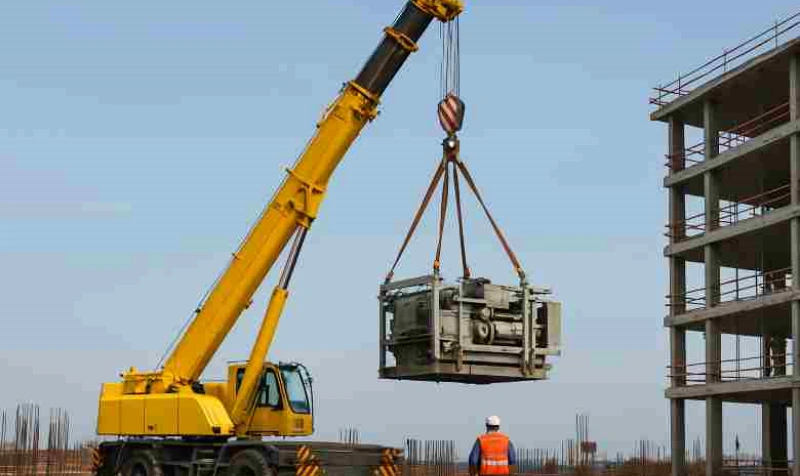
Industrial lifting begins with a metallurgical audit of alloy grades to ensure they handle the specific tension requirements of a site. Grade 100 alloy chains have become the baseline for heavy work in 2026, providing a 25% higher capacity than Grade 80 for the same physical footprint. A 2024 study on 500 samples showed that chains with surface hardness between 38 and 42 HRC maintain the best balance between wear resistance and ductility.
Maintaining a minimum 20% elongation before fracture is a mandatory safety requirement for industrial lifting and rigging. This stretch provides a visual warning to operators that the system is overloaded, which prevented 35% of catastrophic failures in 2023 mining trials.
This visual safety margin allows for immediate intervention before the metal reaches its ultimate breaking force under high-stress cycles. Once the chain grade is confirmed, the focus moves to the compatibility of connecting hardware like shackles, master links, and hooks.
Every component in a system must share a uniform safety factor of 4:1 or 5:1 to prevent mechanical mismatches. Mixing vendors often leads to a 12% mismatch in tolerance levels, causing point-loading on shackles not designed for specific link geometries. A specialized manufacturer that supplies matched hardware ensures a ±0.5mm fit between different components.
-
Master Links: Must be oversized to fit crane hooks while maintaining 200% proof-load capacity.
-
Clevis Hooks: Integrated pins eliminate extra connectors, reducing the total assembly weight by 10%.
-
Shackles: Bolt-type anchor shackles stay secure under vibration during long-term industrial lifts.
Data from 2024 safety inspections revealed that 18% of failures were caused by hardware lacking a matching test certificate for the chain. Procurement should mandate a single Certificate of Test and Examination for the entire lifting set.
The documentation must include the results of the Charpy V-notch impact test, measuring energy absorption at sub-zero temperatures. For projects in arctic or offshore zones, a minimum energy absorption of 40 Joules at -20°C is the standard for ensuring metal stays tough. Ropes and chains that fail this metric are 40% more likely to shatter under shock loads in cold climates.
| Equipment Type | Material Standard | Safety Factor | Performance Metric |
| Alloy Chain | EN 818-2 / Grade 100 | 4:1 | 20% Min. Elongation |
| Wire Rope | ISO 2408 / 35x7 | 5:1 | 1.5% Max. Torque Factor |
| Shackles | ASTM A148 | 6:1 | 100% MPI Crack Detection |
| Lifting Beams | ASME B30.20 | 3:1 | Deflection < 1/1000 span |
Rotation-resistant wire ropes, particularly those with a 35x7 construction, are necessary for high-lift cranes to prevent load spinning. A 2025 report on tower crane operations found that using 35x7 ropes reduced load-swing incidents by 65% compared to standard 6-strand ropes. These ropes use inner and outer layers that twist in opposite directions to cancel out internal torque.
Effective design also involves surface treatments matched to the environment to prevent hydrogen embrittlement and oxidation. Hot-dip galvanizing or zinc-aluminum coatings are standard for marine use, providing 500 to 1,000 hours of salt spray resistance under ISO 9227. A 2023 survey of port equipment showed that galvanized assemblies lasted three times longer than those with a black oxide finish.
Surface corrosion that removes 10% of the cross-section of a wire rope can reduce breaking strength by 30%. Pressure-injected lubrication during manufacturing ensures the core remains shielded from the inside out.
Internal lubrication is vital for multi-layer spooling winches where the rope is subjected to high crushing forces. A 2024 engineering test on 200 winch drums showed that ropes with compacted strand architecture had 20% better resistance to flattening. Compaction flattens the outer wires of the rope, creating a smoother surface that distributes pressure evenly across sheave grooves.
Traceability remains a check for industrial projects, requiring every piece of equipment to be embossed with a unique tracking code. In 2025, over 70% of North American industrial sites began requiring QR codes on all hardware for digital access to melt shop heat numbers. This ensures that phosphorus and sulfur levels in the steel are kept below 0.02% to prevent internal defects.
Digital traceability also allows site managers to track the inspection history and age of each component in real-time. By monitoring the number of lift cycles, operators replace equipment before it reaches the end of its 20,000-cycle fatigue life. This data-driven approach to selection ensures that projects stay within the calculated safety margin.
Finalizing the selection requires a review of the manufacturer's internal testing lab and their adherence to ISO 9001:2015 quality standards. A factory that performs 100% Magnetic Particle Inspection (MPI) on all forged hardware catches microscopic surface cracks that visual checks miss. Choosing products that have undergone these verification steps ensures the safety of personnel and the security of the load.
Ship generative AI without leaking prompts, models, or data.
Book 30 minutes with a Shaiex solutions architect to map How to choose lifting and rigging products for heavy-duty industrial projects? against your stack.